Launch offer — valid today only

📄 Digital book in PDF · read it on your phone or print it

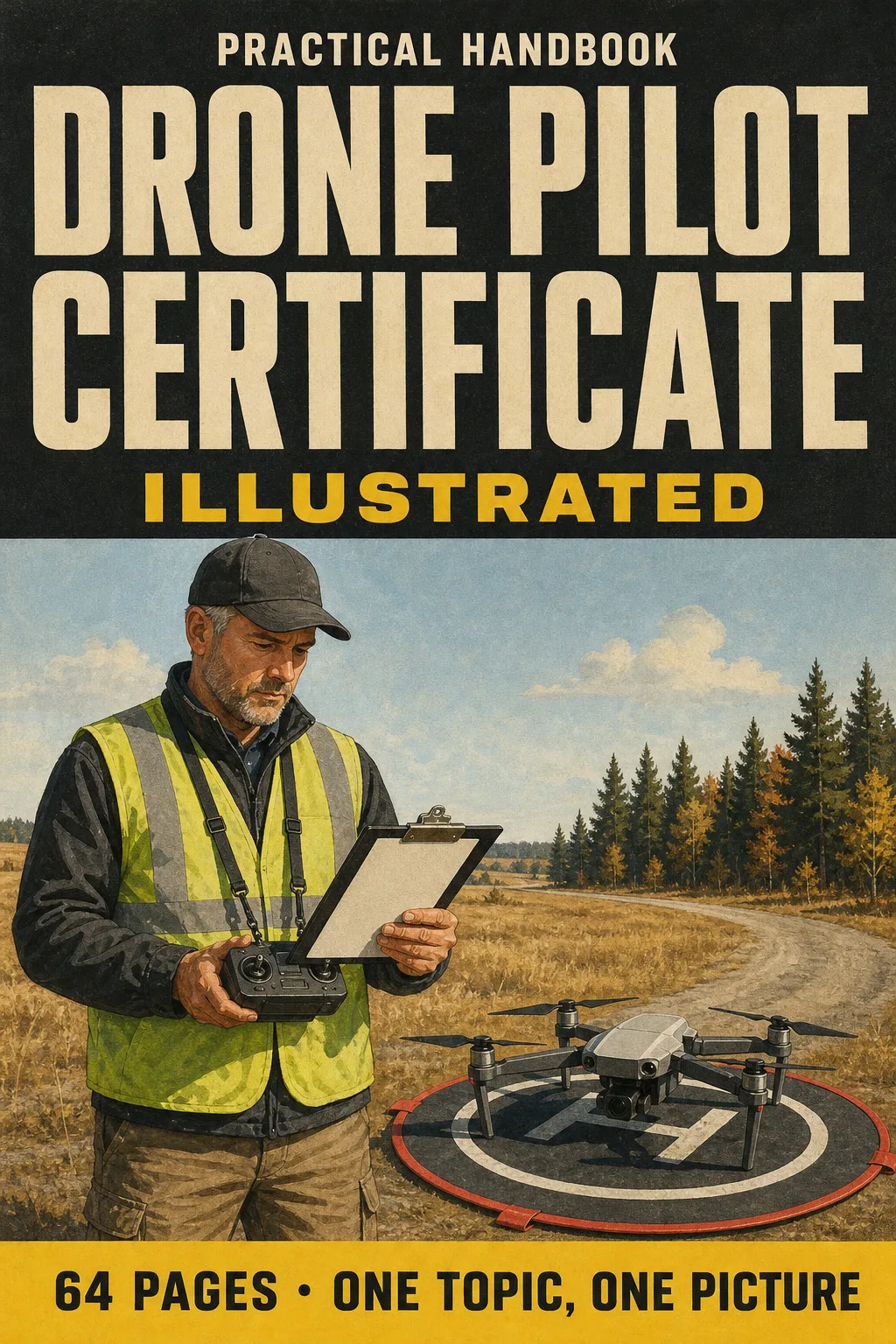
The Transport Canada Drone Exams in Drawings: Know Where You Can Fly at a Glance One Rule on Every Page

Drone categories, Class G and controlled airspace, VNC and VTA charts, line of sight, wind at 120 m, LiPo batteries, fly-aways and the pre-flight checklist. Every topic has its own page: the drawing first, then what you need to remember. 64 illustrated pages.

SHOW ME EVERY DRONE RULE, DRAWN

🔒 Secure checkout · PDF by email · 30-day guarantee

Every topic, its own pageEach rule drawn, with the explanation beside it
64 illustrated pages8 parts, from your drone and certificate to the field checklists
Up-to-date sourcesTransport Canada CARs Part IX with the 2025 amendments, the knowledge requirements (TP 15263) and NAV CANADA charts
PDF by emailFormat

Look Inside the Book

Every page has a big drawing and a box with the numbers and rules you need to know:

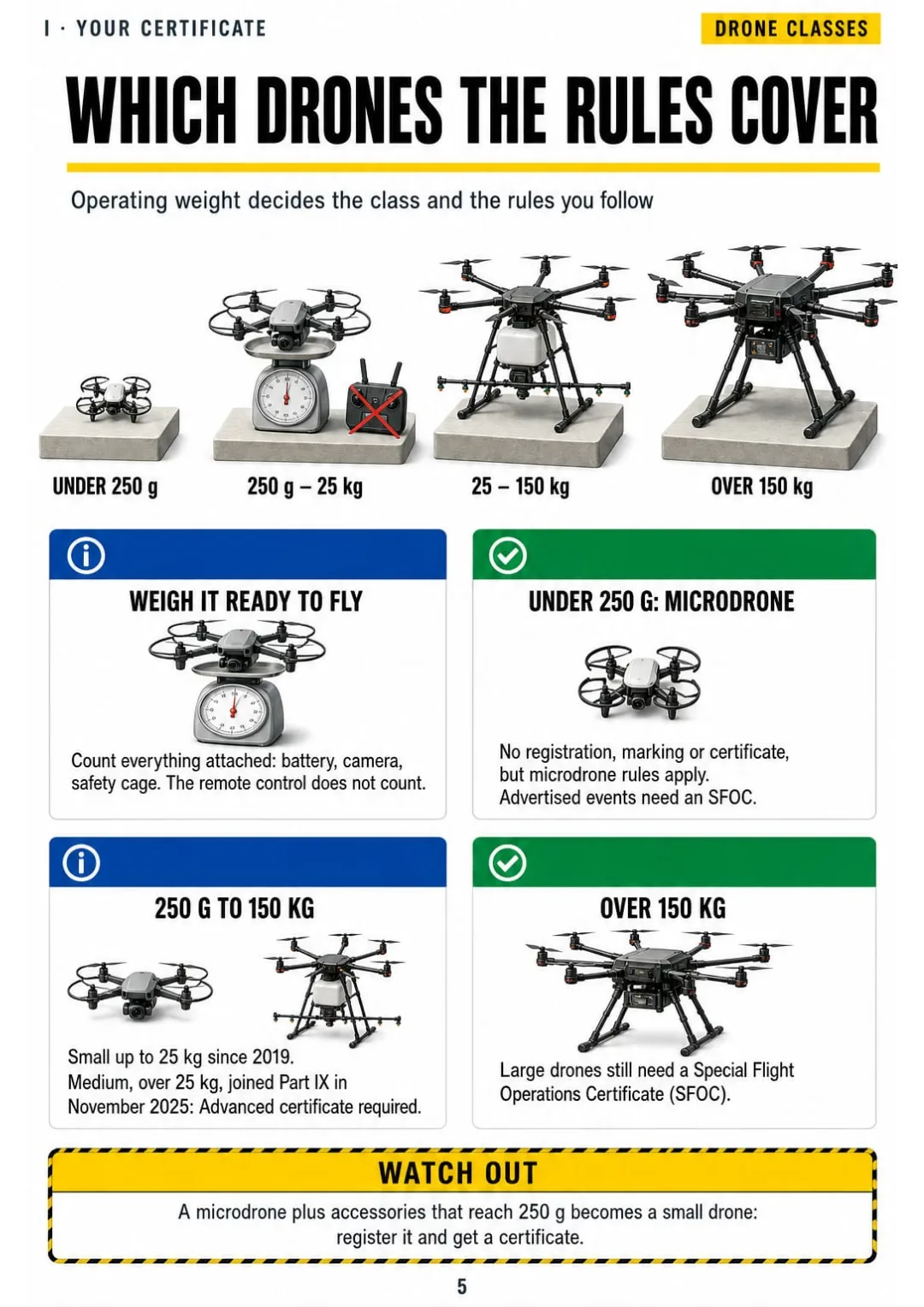
Microdrone under 250 g · small 250 g–25 kg · medium to 150 kg · large over 150 kg
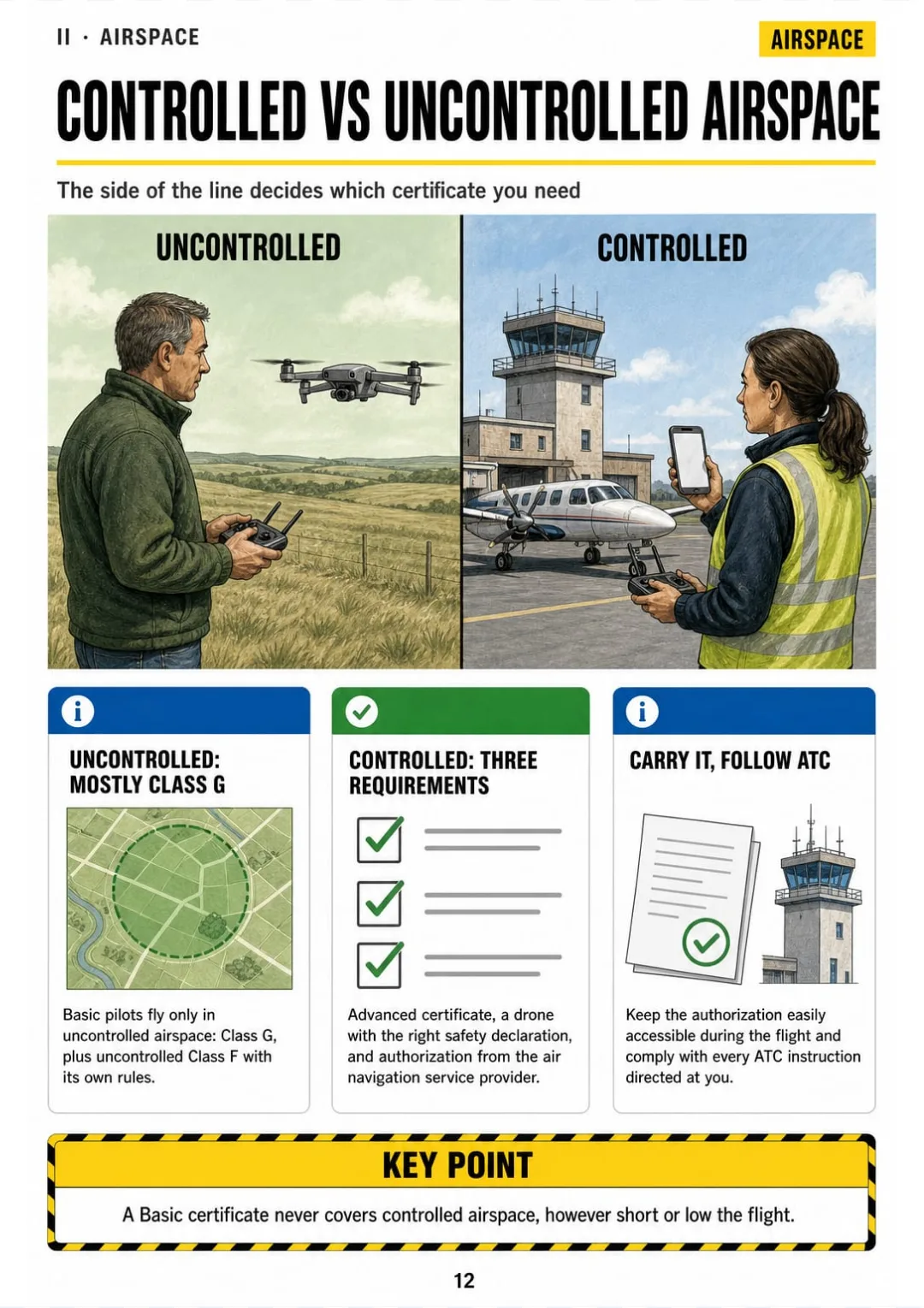
Basic = Class G only. Controlled airspace = Advanced + declared drone + authorization.
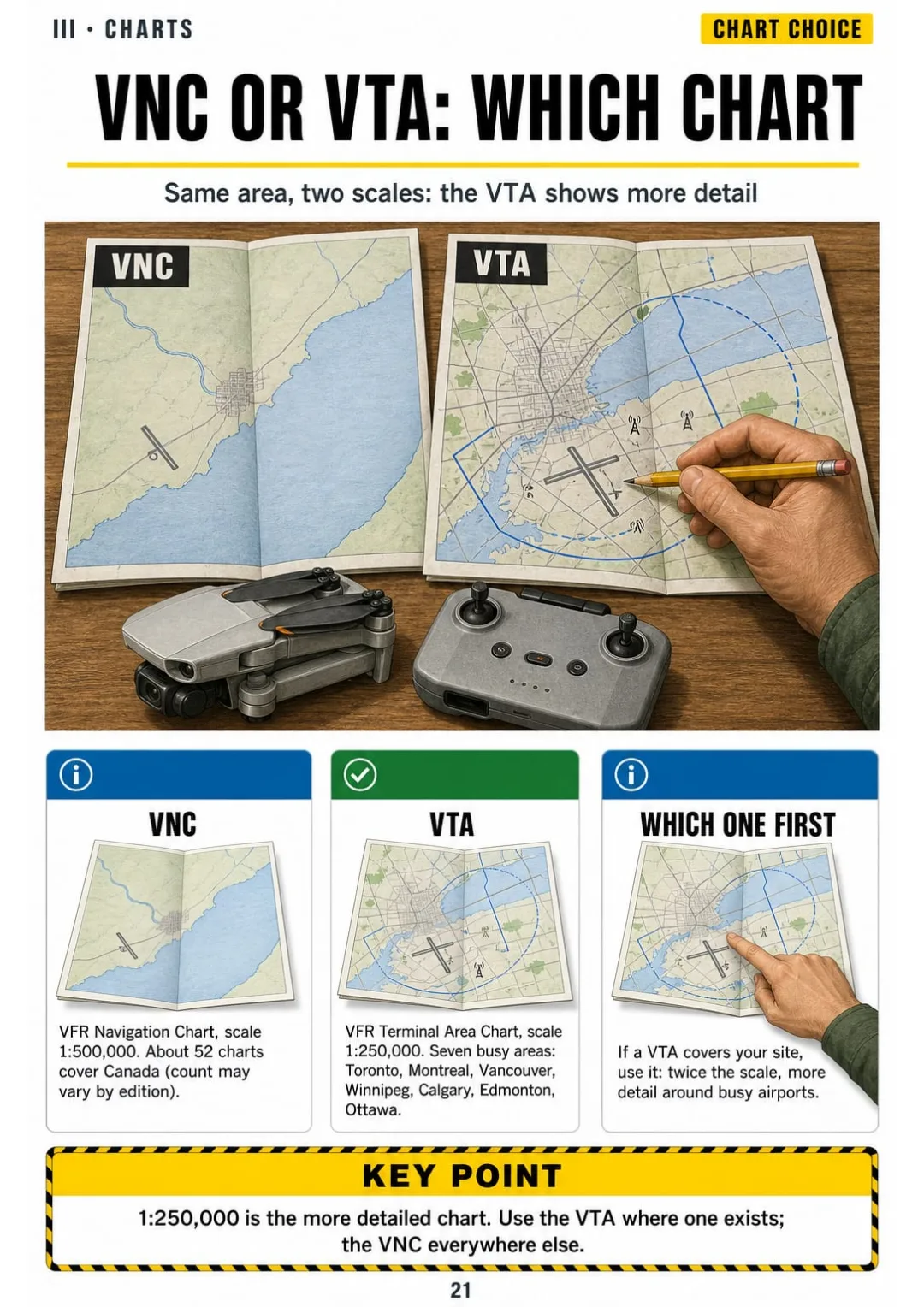
VNC 1:500,000 vs VTA 1:250,000: same area, twice the detail near busy airports.
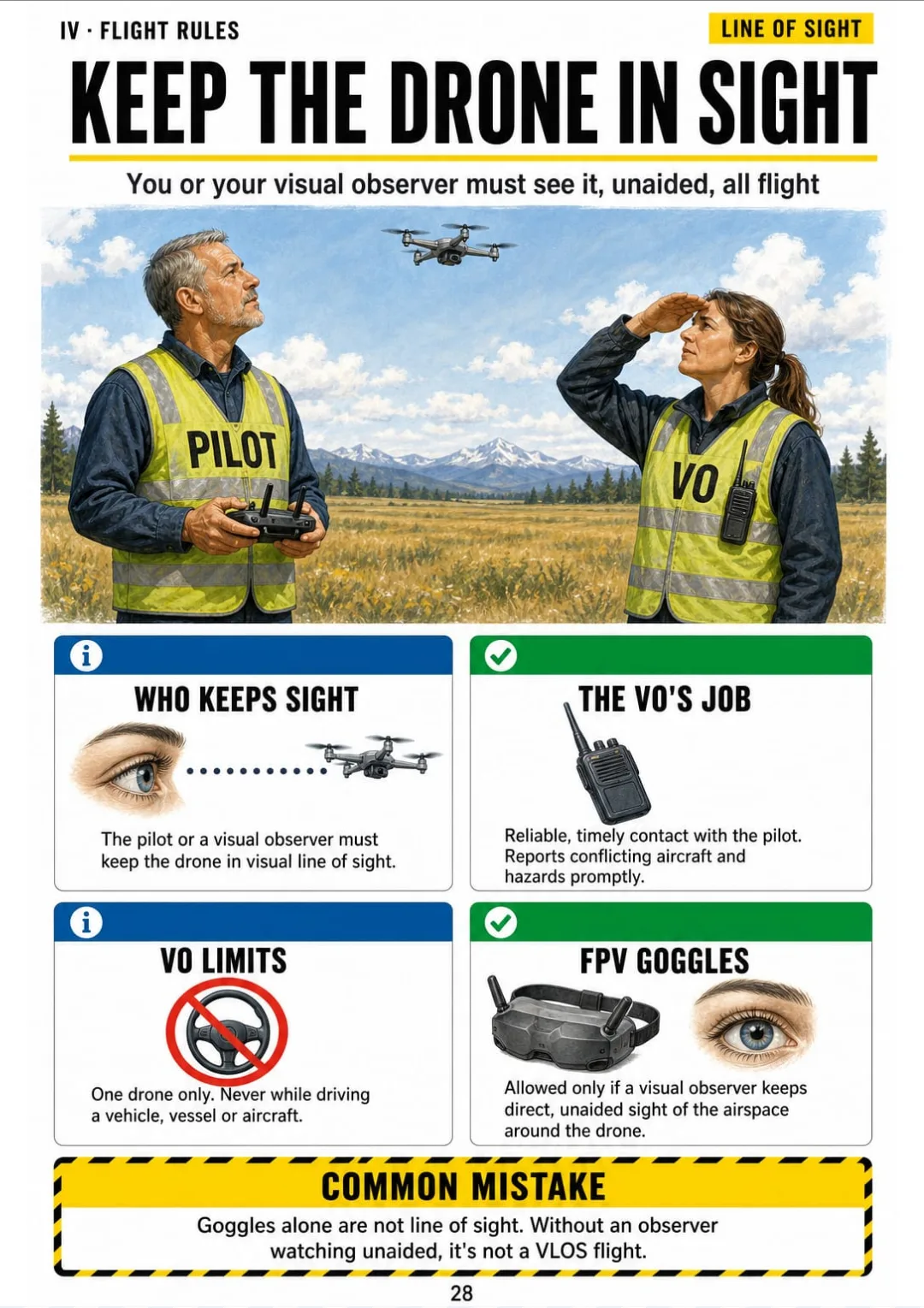
VLOS: pilot or VO sees the drone unaided; FPV only with an observer watching.
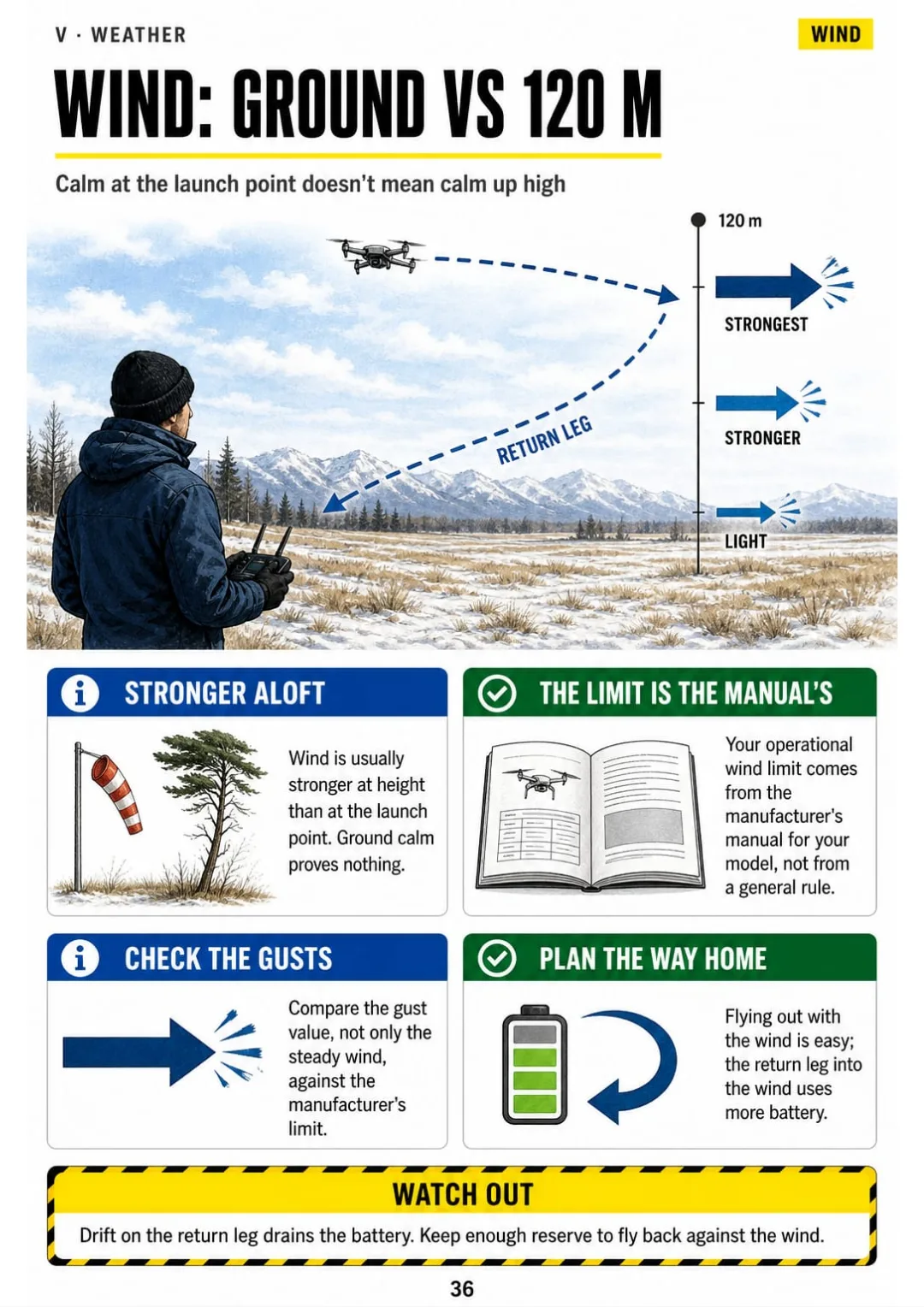
Wind is usually stronger aloft: check gusts against the manufacturer's limit and plan the return leg.
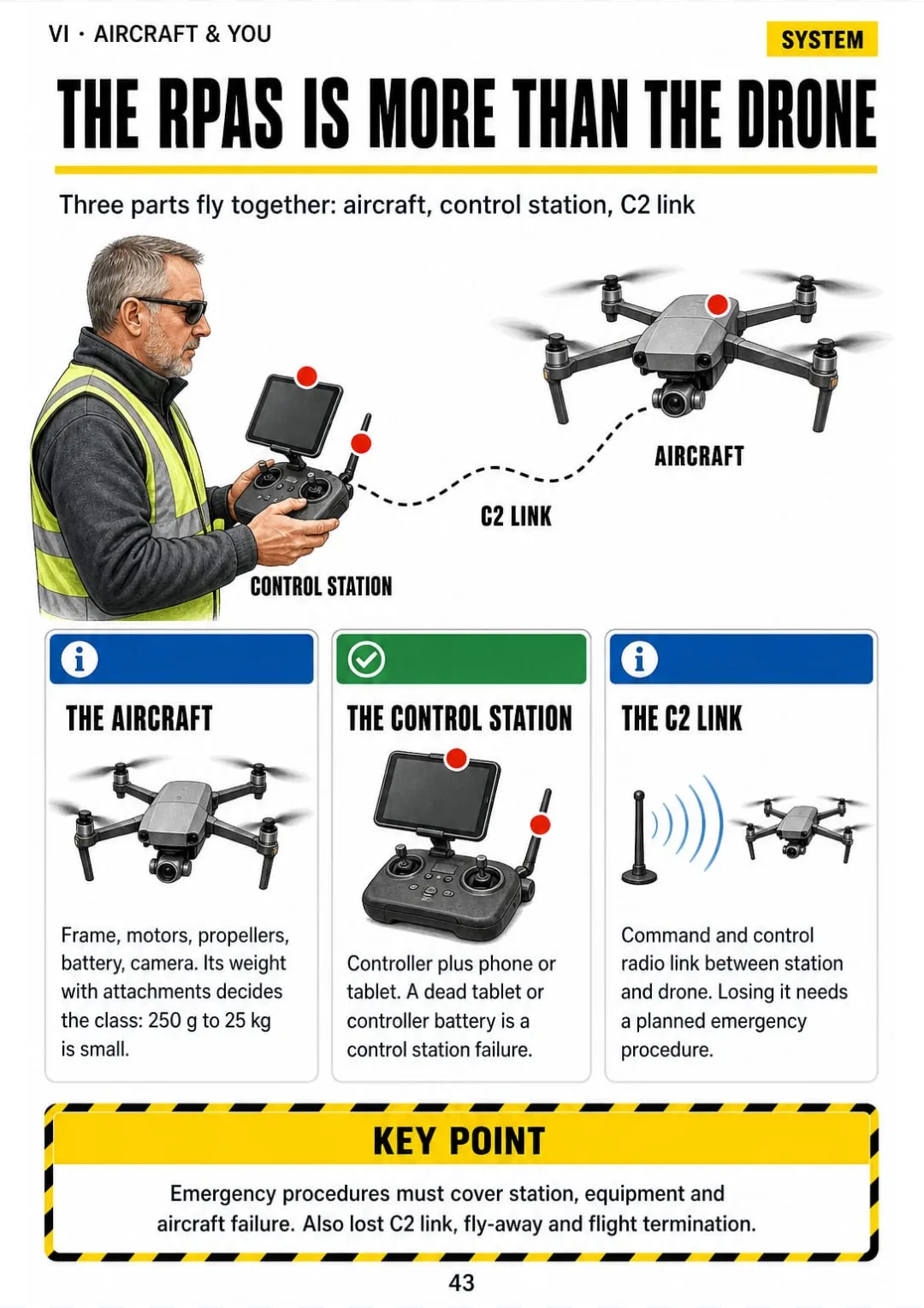
Aircraft, control station and C2 link: the three parts of an RPAS, drawn and labelled.
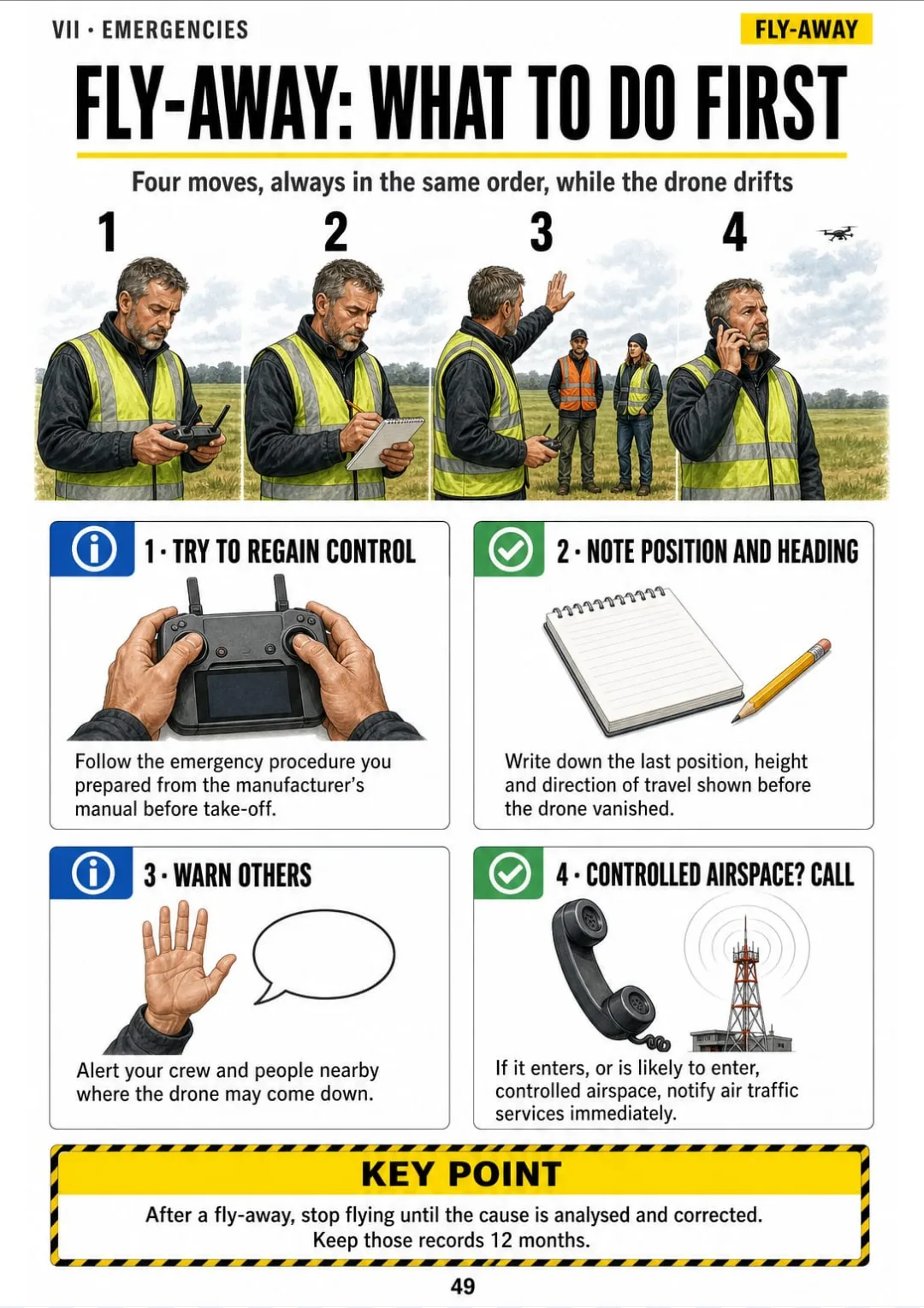
Fly-away: if it heads into controlled airspace, notify air traffic services immediately
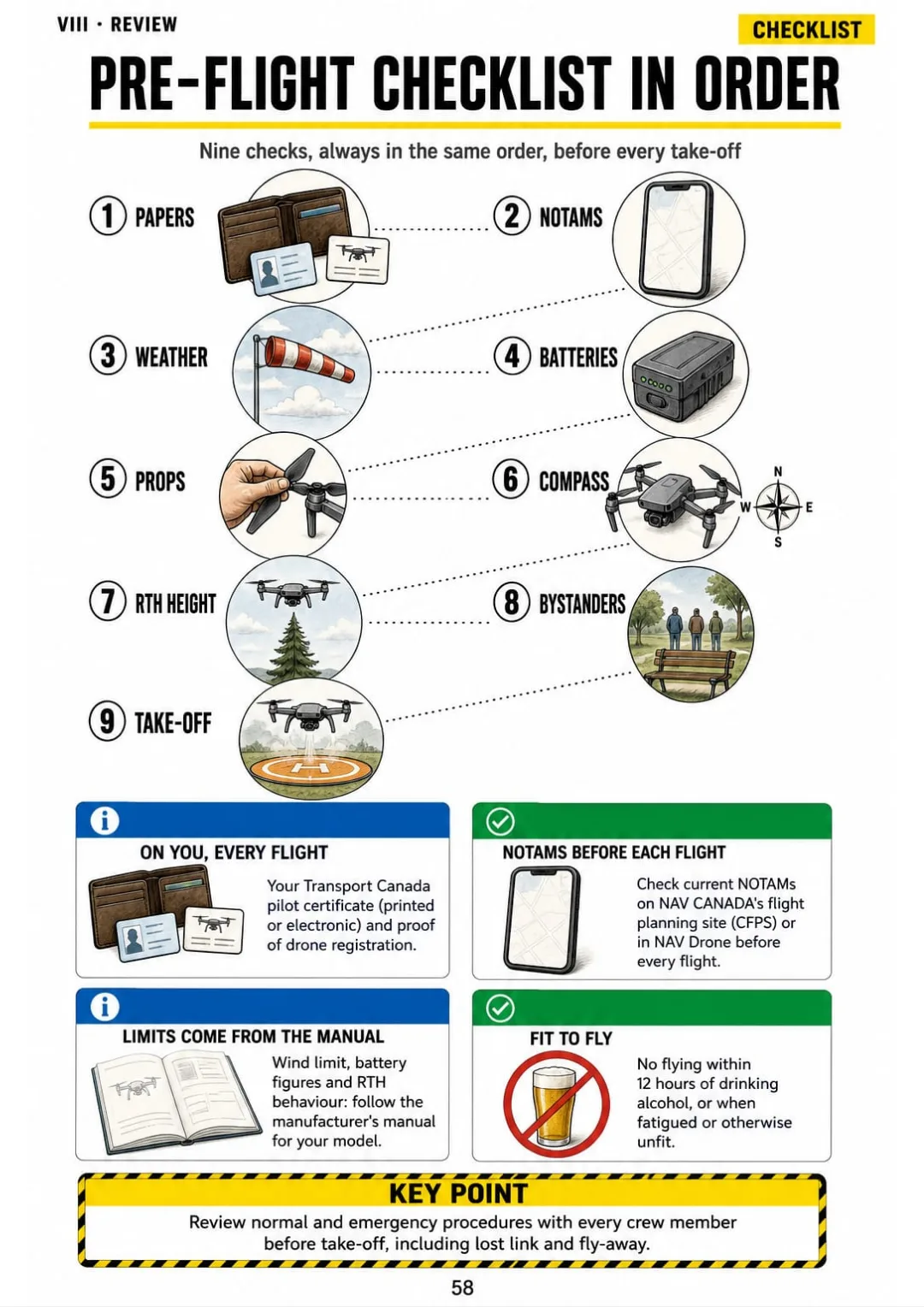
From papers to take-off: 9 checks, always in the same order

Swipe to see more →

These are real pages from the book. The table of contents is the full one: 8 parts and 60 topics.

The Problem Isn't You. It's How It Was Explained to You.

You're planning a flight near a town with a regional airport. The chart is open on your screen and you're not even sure it's the right one: VNC or VTA?

The guide explains it in paragraphs: scales, coverage, terminal areas. You read it, it makes sense, and an hour later the two names blur together.

VNC 1:500,000 vs VTA 1:250,000: same area, twice the detail near busy airports.

In the book it's one page: the same area drawn twice, side by side. VNC at 1:500,000, VTA at 1:250,000: twice the detail near busy airports. You see the difference before you read a word.

Same with Class G and controlled airspace, ASL vs AGL, reading a NOTAM, distances from heliports and wind at 120 m: each one has its own page.

So you pick the right chart, read the label and know whether you can fly there, without going back to the guide.

COMPARE FOR YOURSELF

The Same Topic, Two Ways to Study It

THIS
  • The guide: line after line
  • Airspace classes explained only in words
  • You write the exam still unsure
Canadian domestic airspace is classified as either controlled or uncontrolled. Controlled airspace comprises Classes A, B, C, D and E, within which an air traffic control service is provided in accordance with the applicable class designation. Class G airspace is uncontrolled. A pilot holding a basic operations certificate may conduct operations only in uncontrolled airspace, whereas operations in controlled airspace require an advanced operations certificate, an aircraft meeting the applicable manufacturer declaration, and an authorization issued by the air navigation services provider prior to the flight.
FOR THIS
  • Controlled airspace in one drawing
  • Who can fly where, in a box
  • You see it and you get it
Basic = Class G only. Controlled airspace = Advanced + declared drone + authorization.
CONTENTS

Take a Look at the 8 Parts and 60 Topics

Your drone and certificate, airspace, charts, flight rules, weather, the aircraft and batteries, emergencies and Advanced operations, and field checklists: 64 pages, all illustrated.

IYour Drone and Your Certificate · pp. 5-11
  1. Which drones the rules cover
  2. Basic or Advanced: three questions decide
  3. Registering your drone
  4. The Basic exam at a glance
  5. The Advanced path: exam, then flight review
  6. Age limits and supervision
  7. What to carry and how to stay current
IIAirspace Drawn as Layers · pp. 12-20
  1. Controlled vs uncontrolled airspace
  2. Class G: where Basic pilots fly
  3. Classes C, D and E: the stacked layers
  4. Class F: restricted, advisory and danger areas
  5. Distances from airports and heliports
  6. Uncertified aerodromes, water aerodromes and hospital helipads
  7. Emergency security perimeters
  8. Parks, towns and other land rules
  9. Asking for authorization in controlled airspace
IIIReading Aeronautical Charts · pp. 21-27
  1. VNC or VTA: which chart and why
  2. Reading an airspace label
  3. ASL vs AGL: the conversion that trips people
  4. Aerodrome and obstacle symbols
  5. The Canada Flight Supplement
  6. Reading a NOTAM
  7. Planning a flight site step by step
IVFlight Rules in the Same Order · pp. 28-35
  1. Visual line of sight and visual observers
  2. The height limit: 122 m above ground
  3. Distances from bystanders
  4. Right of way: crewed aircraft always first
  5. Flying at night
  6. Alcohol, drugs and fitness to fly
  7. Events and operations outside the rules
  8. Privacy and other laws
VWeather for Drone Pilots · pp. 36-42
  1. Wind: on the ground vs at 120 m
  2. Reading a METAR
  3. Reading a TAF
  4. Graphic Area Forecast
  5. Density altitude: hot, high and humid
  6. Cold, icing and Canadian winters
  7. Visibility, fog, rain and cloud
VIThe Aircraft, the Batteries and You · pp. 43-48
  1. Parts of a drone system
  2. LiPo batteries: charge, storage, swelling
  3. GNSS, compass and interference
  4. Return-to-home: what it doesn't do
  5. Maintenance and the drone's records
  6. Human factors: are you fit to fly?
VIIEmergencies and Advanced Operations · pp. 49-57
  1. Fly-away: what to do first
  2. Lost C2 link
  3. A crewed aircraft appears
  4. Low battery and forced landing
  5. What you must report
  6. Radio phraseology and the phonetic alphabet
  7. Manufacturer declarations: what your drone is allowed to do
  8. Site survey before an Advanced flight
  9. The flight review: what the reviewer checks
VIIIReview and Field Checklists · pp. 58-64
  1. Pre-flight checklist in order
  2. Basic vs Advanced side by side
  3. The numbers to know
  4. Pairs that get mixed up
  5. Frequent mistakes in the field
  6. Before you start the online exam
  7. Staying up to date with the rules

One Page, One Topic, All Clear

Think of it this way:

A client wants roof photos, and the house sits a few kilometres from a hospital helipad. Before you unpack the drone, you need to know whether you can fly there.

You open the book at distances from airports and heliports and see it drawn on a map: the aerodrome, the distances around it, and where Basic ends and Advanced begins.

Wind is usually stronger aloft: check gusts against the manufacturer's limit and plan the return leg.

Same with Class G, VNC and VTA charts, line of sight, wind at 120 m and fly-aways: each one on its own page.

Drone Pilot Certificate Illustrated is 8 parts and 64 illustrated pages, one topic per page, with a review section and field checklists at the end.

What you see drawn, you don't have to memorize.

What's Inside Drone Pilot Certificate Illustrated:

Ipp. 5-11

Your Drone and Your Certificate

Which drones the rules cover, Basic or Advanced, registration, both exams, age limits and staying current.

IIpp. 12-20

Airspace Drawn as Layers

Controlled and uncontrolled airspace, Classes C to G, distances from airports and heliports, security perimeters and asking for authorization: you look at a spot on the map and know whether Basic is enough.

IIIpp. 21-27

Reading Aeronautical Charts

VNC and VTA charts, airspace labels, ASL vs AGL, aerodrome symbols, the Canada Flight Supplement, NOTAMs and site planning: you open the right chart and read every label on it.

IVpp. 28-35

Flight Rules in the Same Order

Line of sight, the 122 m height limit, bystanders, right of way, night flying, fitness to fly and privacy.

Vpp. 36-42

Weather for Drone Pilots

Wind aloft, METAR, TAF, the Graphic Area Forecast, density altitude, cold and icing, visibility and cloud.

VIpp. 43-48

The Aircraft, the Batteries and You

The parts of an RPAS, LiPo batteries, GNSS and compass, return-to-home, maintenance and human factors.

VIIpp. 49-57

Emergencies and Advanced Operations

Fly-aways, lost C2 link, crewed aircraft, forced landings, reporting, radio phraseology, manufacturer declarations, site surveys and the flight review.

VIIIpp. 58-64

Review and Field Checklists

Pre-flight checklist, Basic vs Advanced, the numbers to know, pairs that get mixed up, field mistakes and exam-day prep.

At the end of the book: A review section with the numbers to know, pairs that get mixed up and a pre-flight checklist.
Plus: 2 Free Books

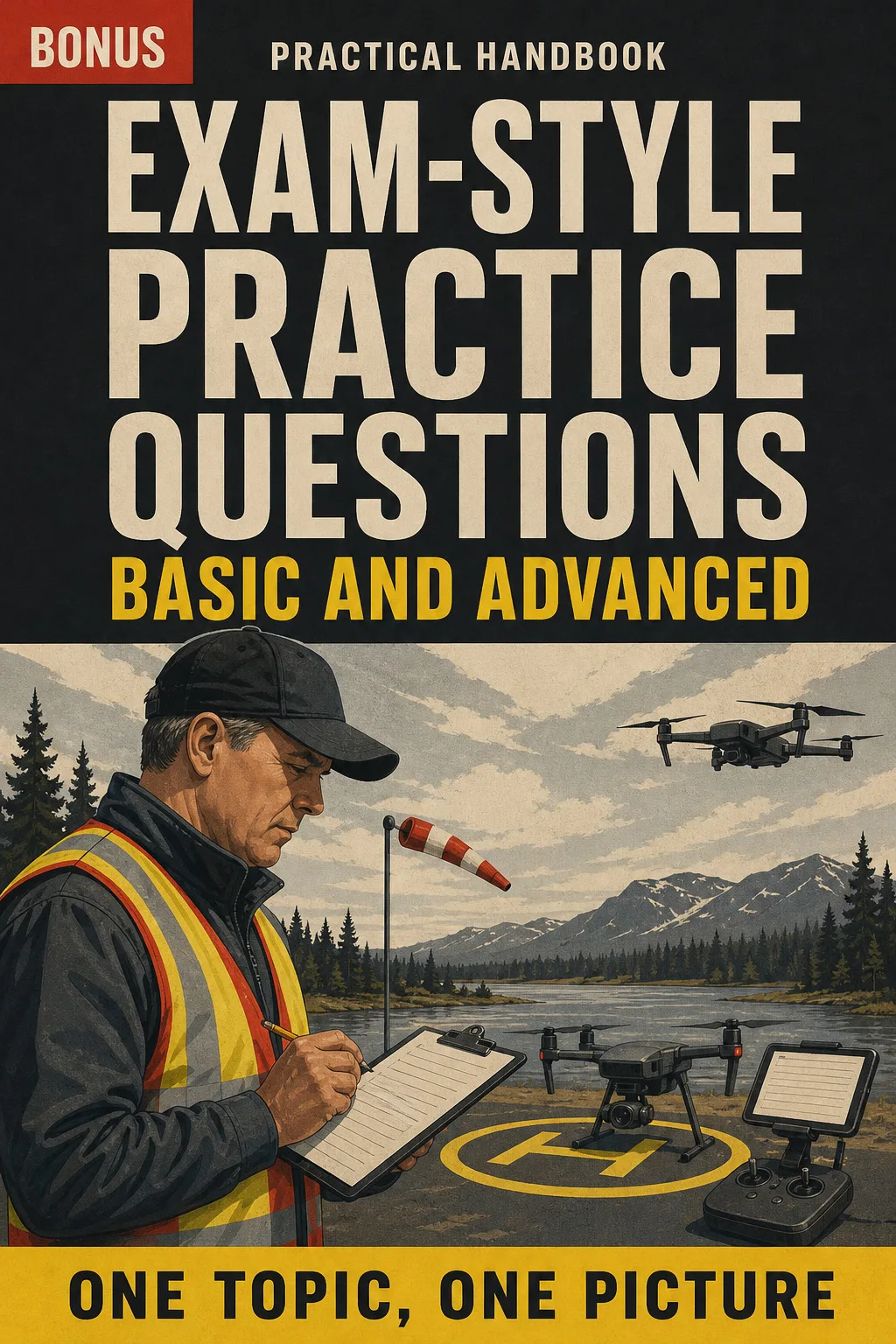
Exam-Style Practice Questions: Basic and Advanced

BONUS 1: «Exam-Style Practice Questions: Basic and Advanced»

Value on its own: US$ 17.90

Test yourself on airspace, rules, weather and emergencies with answers explained, so you know what you know before you sit the online exam.

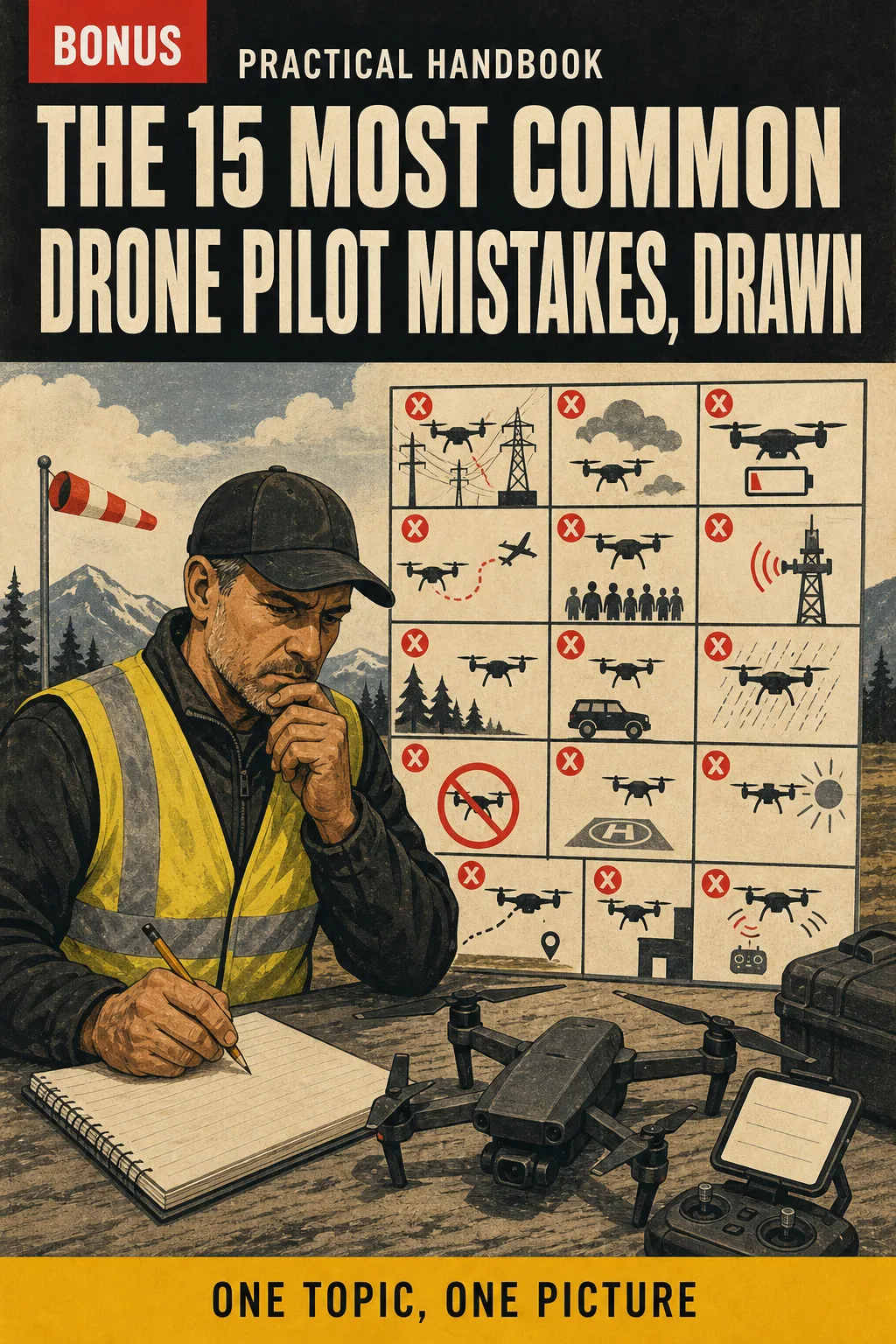
The 15 Most Common Drone Pilot Mistakes, Drawn

BONUS 2: «The 15 Most Common Drone Pilot Mistakes, Drawn»

Value on its own: US$ 14.90

See each frequent mistake next to the right way, side by side, so the confusing rules stop mixing in your head.

Drone Pilot Certificate Illustrated with 2 Free Books

  • Drone Pilot Certificate Illustrated: 64 illustrated pagesUS$ 63
  • BONUS 1: Exam-Style Practice Questions: Basic and AdvancedUS$ 17.90
  • BONUS 2: The 15 Most Common Drone Pilot Mistakes, DrawnUS$ 14.90
  • High-resolution PDF to printIncluded
Total value US$ 95.80
YOUR PRICE:
US$ 27
You save US$ 68.80
YES, I WANT DRONE PILOT CERTIFICATE ILLUSTRATED FOR US$ 27

📄 This is a digital PDF book sent to your email: nothing is printed or shipped.

Secure purchaseEncrypted payment30-day guarantee

PDF by email: We email you Drone Pilot Certificate Illustrated as a PDF, together with the two free books. It's a single payment: no installments, no extra charges.

Who This Book Is For

You just got a drone over 250 g

You just got a drone over 250 g

You see which category it falls in, what the Basic exam covers and where you can fly it, one page at a time.

Your online exam is coming up

Your online exam is coming up

Airspace, charts and rules in the same order every time, plus practice questions to check yourself before you start.

You fly for work

You fly for work

Roof, property or farm jobs: distances, site survey and the pre-flight checklist on paper, ready for the truck.

Everything You Get Today

US$ 95.80US$ 27
YES, I WANT DRONE PILOT CERTIFICATE ILLUSTRATED FOR US$ 27

📄 This is a digital PDF book sent to your email: nothing is printed or shipped.

30DAYS
GUARANTEE

30-Day Guarantee

Try Drone Pilot Certificate Illustrated for 30 days, bonus books included.

We refund everything if the file won't open, if the book isn't what you see here, if you were charged twice or if the email doesn't arrive. Just email us.

You pay once. No subscriptions.

Frequently Asked Questions

Is it for me if I just want my Basic certificate to fly at the cottage or on the farm?

Yes. It starts with which drones the rules cover and the Basic exam. The Advanced topics have their own parts, for when you're ready.

Where does the content come from?

From Transport Canada's CARs Part IX, including the 2025 amendments, the published knowledge requirements (TP 15263) and NAV CANADA's charts, Canada Flight Supplement and NOTAMs. Canadian rules, not US FAA material: metres where the rules use metres (122 m), and the feet and nautical miles you'll actually see on Canadian charts.

Is this official material?

No. It's an independent study book, not affiliated with or endorsed by Transport Canada or NAV CANADA.

Does it give me my drone pilot certificate, or replace ground school?

No. Your pilot certificate comes only from Transport Canada, after you pass the online exam (and the flight review, for Advanced). This book helps you study and review for it. It doesn't replace any course, the exam or the flight review.

Are the practice questions the ones on the exam?

No. They're written for this book so you can check what you know. They aren't official exam questions.

When and how do I get it?

As a PDF by email, with the 2 bonus books, at the address you enter at checkout. One-time payment, no subscription.

Transport Canada's guide is free and there are online courses. Why a book?

The guide gives you the rules in paragraphs; a course gives you hours of video. This book puts each rule on one page, drawn, so you can review the night before or check it in the truck before a job. You can use it alongside the guide.

Can I have it on paper?

Yes. It's a PDF you can print at home or at a print shop and keep in your drone bag.

How does the refund work?

You have 30 days. We refund everything if the file won't open, if the book isn't what you see on this page, if you were charged twice or if the email doesn't arrive: just email us.

Before You Close This Page

No more rereading with nothing sticking.

Airspace classes: you see them drawn, and that's it.

You write the exam knowing where everything is.

Drawings make studying faster.

The book is right below.

One-time payment: US$ 27 · Guarantee: 30 days · PDF by email

YES, I WANT DRONE PILOT CERTIFICATE ILLUSTRATED FOR US$ 27

📄 This is a digital PDF book sent to your email: nothing is printed or shipped.